
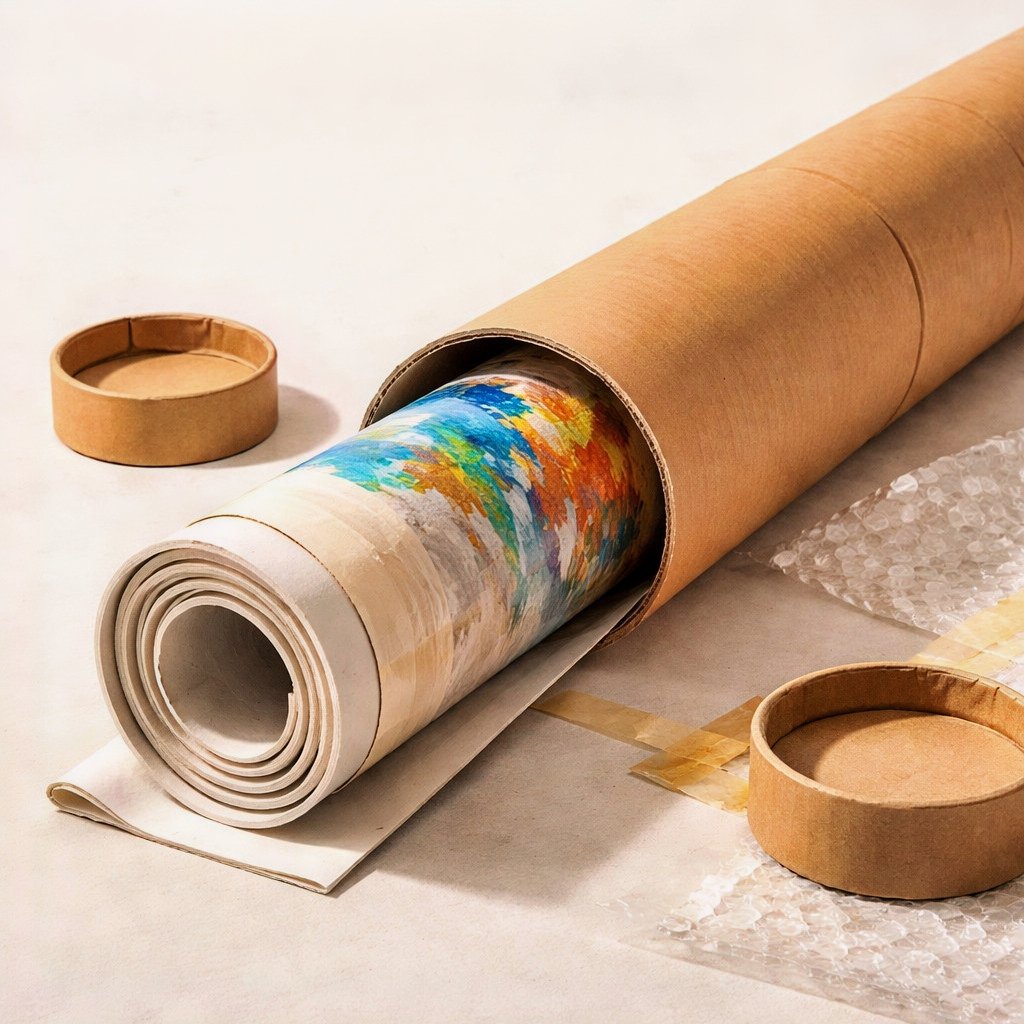
If you are considering buying a large painting, you may be surprised to learn that many artworks are shipped rolled in a tube instead of stretched on a frame. This is not a compromise—it is often the best and safest solution, especially for large formats and international deliveries.
In this guide, we’ll explain why large paintings are shipped rolled, what the advantages are, and why this method is widely used by artists, galleries and collectors around the world.
What Does “Shipped Rolled” Mean?
When a painting is shipped rolled, it means that the canvas is carefully rolled (never folded) and placed inside a rigid protective tube. The artwork is then stretched onto a wooden frame by a professional framer or stretcher at the destination.
This method is standard practice for large and medium-format artworks and is used by many galleries and artists internationally.
Much Safer for Large Formats
Large stretched paintings are vulnerable during transport. Corners, edges and frames can easily be damaged, especially in international shipping.
A rolled canvas:
- Cannot be dented or hit on corners
- Is protected evenly along its entire surface
- Is far less exposed to impact and pressure
For large formats, shipping rolled is often the safest option.
Lower Shipping Costs and Easier Logistics
Shipping a large stretched painting can be extremely expensive because of its size and volume. A rolled canvas, on the other hand:
- Requires a much smaller package
- Reduces shipping and handling costs dramatically
- Makes international delivery simpler and more reliable
This is one of the main reasons why rolled shipping is standard for large artworks worldwide.
Better for International Shipping
When artworks travel across borders, they may go through multiple handling points, customs inspections and transport stages. A rolled canvas inside a rigid tube is:
- Easier to handle
- Less likely to be damaged
- Less exposed to environmental stress
For collectors buying art internationally, this method offers peace of mind and more predictable delivery conditions.
Does Rolling Damage the Painting?
When done correctly, no. Professional artists use high-quality canvases and proper techniques that allow the artwork to be rolled and later stretched without any damage.
The canvas is rolled with the painted surface facing outward and with the correct diameter, avoiding stress or cracking.
What Happens After You Receive the Painting?
Once the artwork arrives, it is taken to a local professional framer or canvas stretcher, who will:
- Stretch the canvas onto a wooden frame
- Ensure correct tension and alignment
- Prepare it for hanging
We explain this process in detail in this guide: How to Stretch a Canvas After Buying a Rolled Painting.
Why This Is Often the Best Option for Large and Custom Art
For large or custom-sized artworks, shipping rolled is often the only practical and sensible solution. It allows:
- Much larger formats to be shipped safely
- Lower total costs
- Better protection of the artwork
This is why most large-scale and custom projects use this method. You can see how this works in practice in our Projects section.
Common Misconceptions
- “Rolled means lower quality” — false. It is a professional standard.
- “It will damage the paint” — not if done correctly with proper materials.
- “It’s complicated to stretch” — any professional framer can do it easily.
Closing Thoughts
Shipping large paintings rolled is not a compromise—it is a smart, safe and practical solution used worldwide. It protects the artwork, reduces costs and makes it possible to ship large and ambitious pieces internationally.
If you are considering a large or custom artwork, you can explore how projects and logistics are handled in our Projects section.