
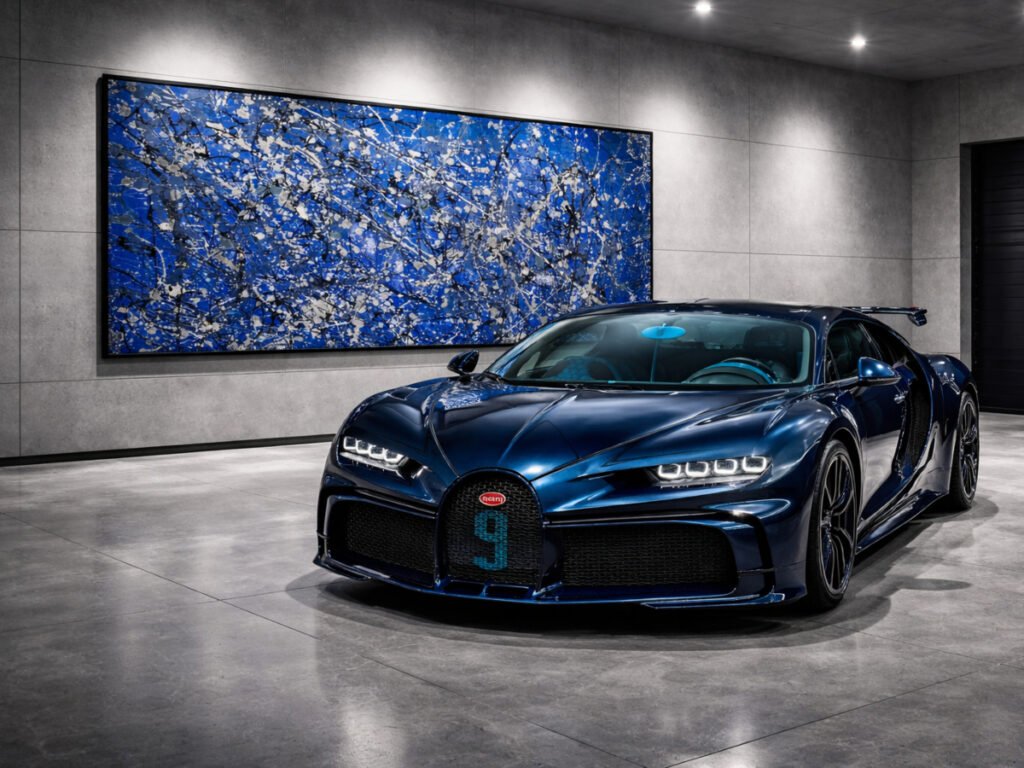
When Automotive Spaces Become Curated Art Environments
In the world of luxury automotive collecting, the garage has evolved far beyond its functional origins.
It is no longer simply a place to store machines.
It is a private gallery.
A design statement.
An extension of the collector’s identity.
As hypercars and classic investment vehicles have become sculptural objects in their own right, the environments that house them have transformed accordingly — blending architecture, lighting design, and increasingly, large-scale abstract art.
Today, the most exclusive automotive spaces are conceived not as storage facilities, but as immersive exhibition environments.
From Garage to Gallery
Luxury garages now rival contemporary art galleries in both aesthetic ambition and spatial design.
Polished concrete or epoxy floors reflect light like museum surfaces.
Architectural wall panels frame vehicles as if they were installations.
Climate control preserves not only engines — but canvases.
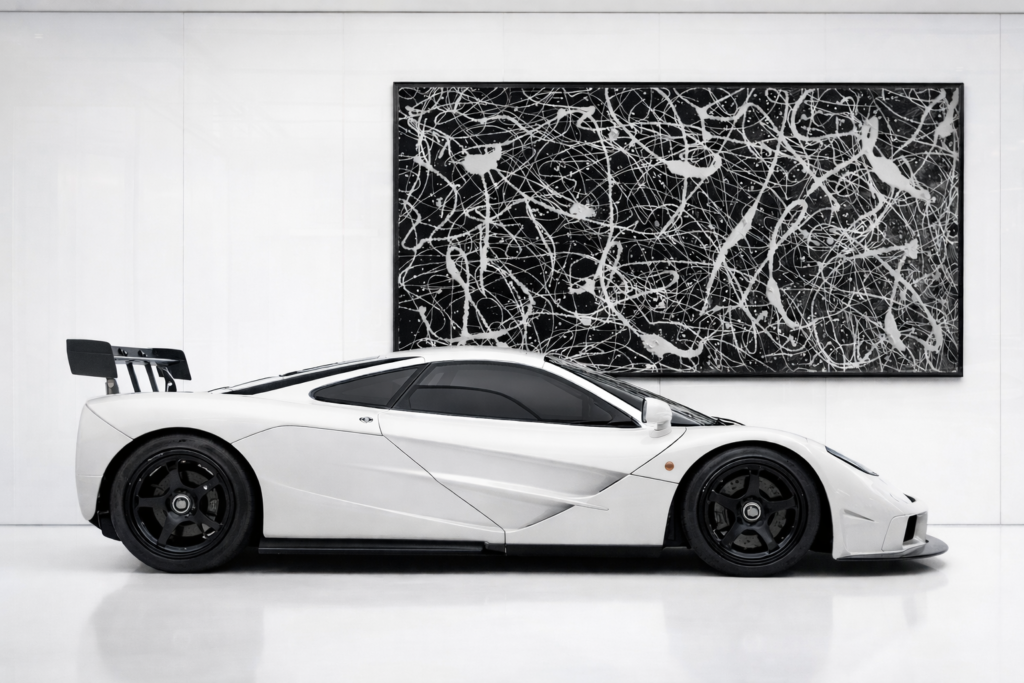
Within this context, the automobile is no longer the sole visual protagonist.
Art enters as its visual counterpart.
Abstract works, in particular, have become the dominant language in these spaces — bringing movement, energy, and emotional charge to environments defined by engineering precision.
The Visual Dialogue Between Art and Automobiles
High-performance vehicles are designed to provoke emotion.
Surface reflections, aerodynamic lines, exposed carbon fiber, and metallic paint finishes all contribute to their sculptural presence.
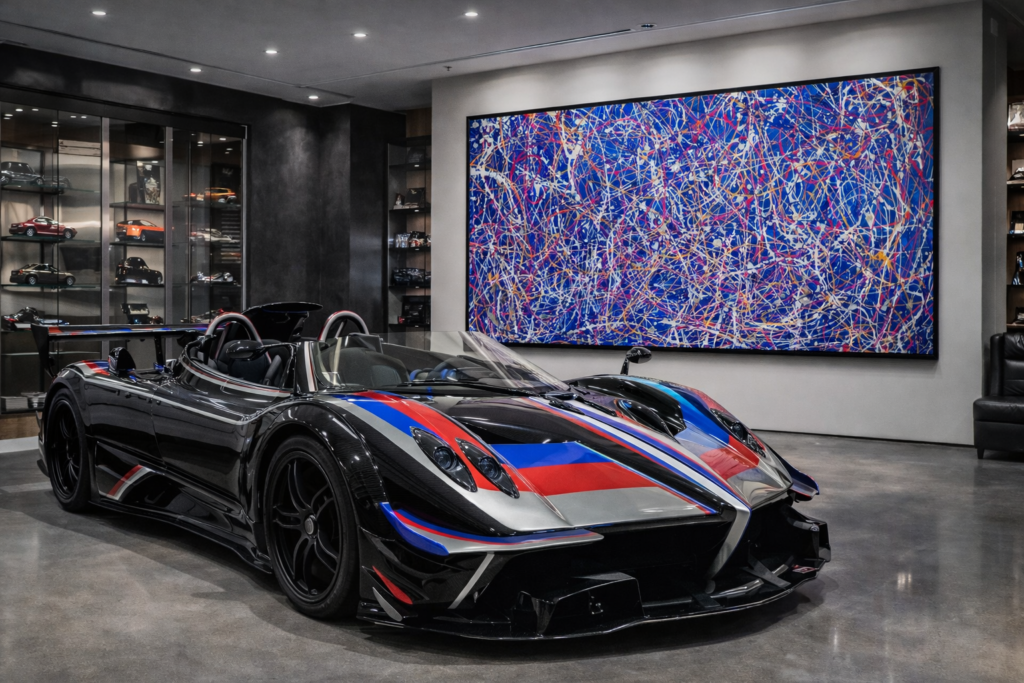
Abstract art amplifies these qualities rather than competing with them.
Collectors often find visual harmony in pairings such as:
- Carbon fiber textures mirrored in layered paint splatter
- Metallic automotive finishes contrasted with matte pigments
- Aggressive body lines framed by gestural abstraction
- Monochrome vehicles paired with high-contrast canvases
The result is a spatial dialogue — machine and artwork speaking the same expressive language.
One embodies motion physically.
The other captures it visually.
Designing the Blue-Chip Automotive Gallery
For high-end collectors, garage curation has become a discipline in itself.
Many commission architects and designers to create rotating exhibition spaces where vehicles and artworks coexist.
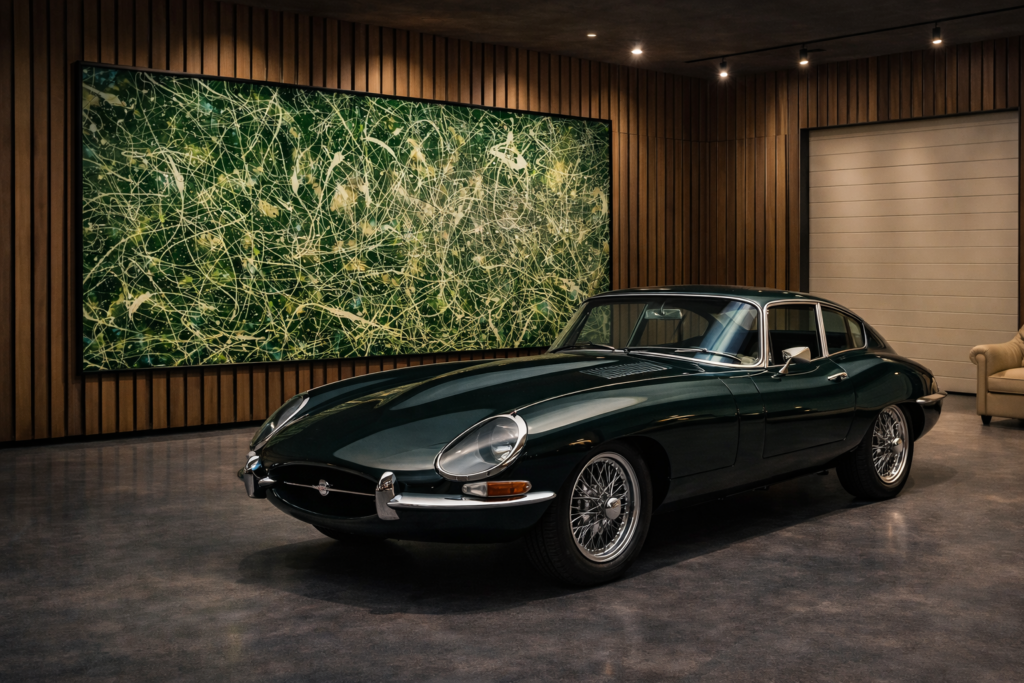
These environments often include:
- Spotlighted vehicle podiums
- Large-format abstract canvases
- Sculptural or kinetic lighting installations
- Acoustic wall treatments
- Gallery-scale negative space for visual breathing room
The goal is immersion — transforming ownership into experience.
Why Abstract Art Works So Powerfully in Automotive Spaces
Among all contemporary styles, abstract expressionism resonates most naturally within car environments.
Its visual attributes align seamlessly with automotive culture:
Motion — captured through gesture and paint dynamics
Power — expressed via explosive composition
Texture — echoing engineered complexity
Layering — mirroring mechanical depth
Color — complementing bespoke automotive finishes
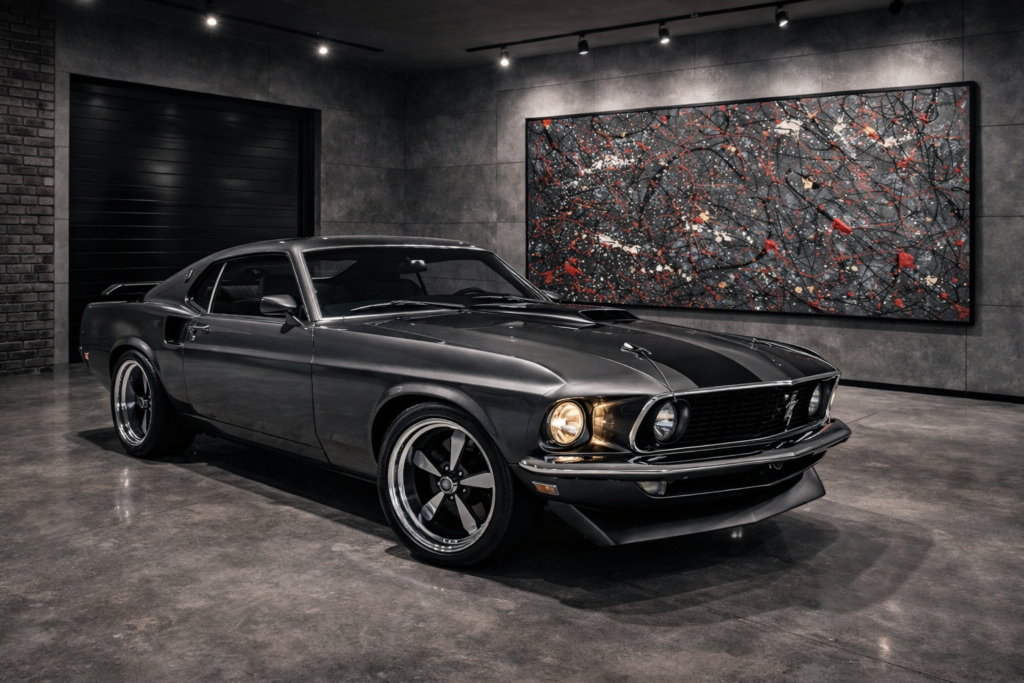
Rather than depicting cars literally, abstract art channels the sensation of driving — speed, vibration, impact, control.
It translates mechanical energy into visual emotion.
Scale Matters — Choosing the Right Format
Luxury garages demand artworks that hold spatial authority.
Small canvases often disappear beside vehicles designed at monumental scale.
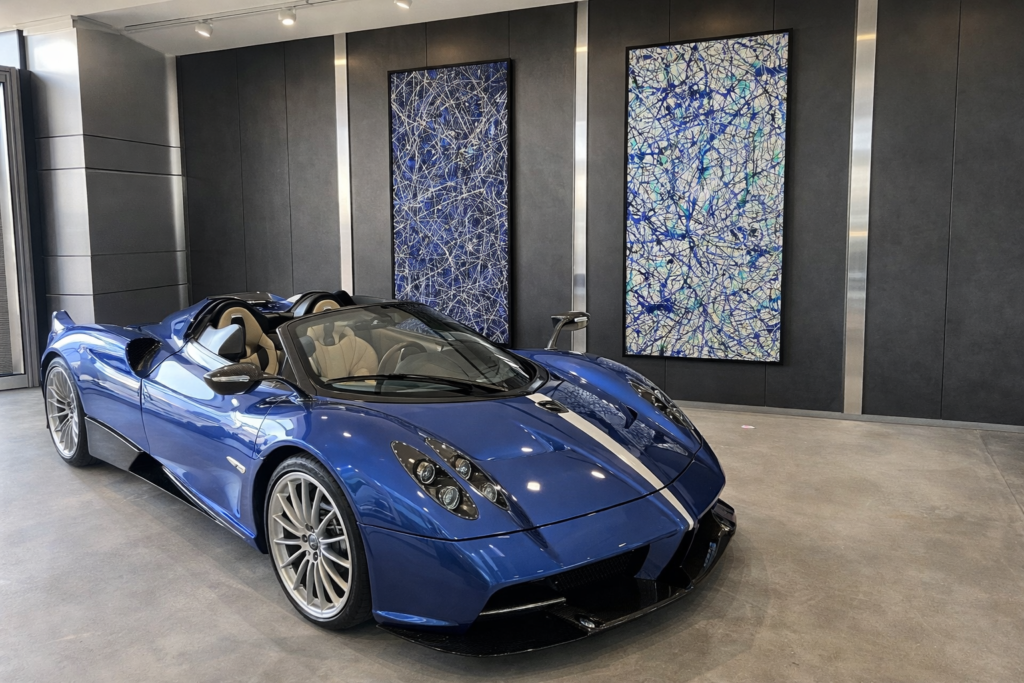
For this reason, collectors frequently select:
- Large horizontal canvases behind vehicle podiums
- Triptych compositions for architectural walls
- Oversized statement pieces for central sightlines
- Commissioned works scaled to specific cars
The objective is balance — ensuring the artwork visually anchors the space without overwhelming the vehicle.
Translating Motion to Canvas
Within this intersection of art and automotive culture, KooK’s work finds a natural home.
KooK’s abstract paintings are driven by movement, velocity, and controlled impact — created through dynamic paint techniques that echo mechanical force and kinetic release.
Layered splashes, directional gestures, and high-energy compositions create visual rhythms reminiscent of acceleration, torque, and speed.
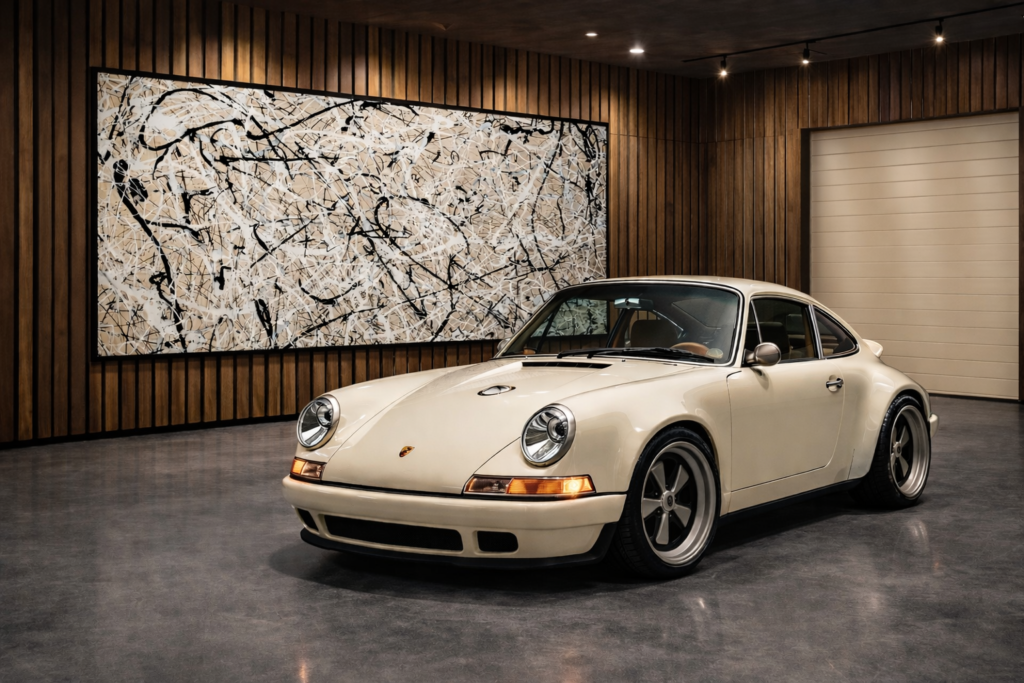
Large-format works are particularly suited to luxury garages, where scale and presence are essential.
They do not merely decorate the wall.
They energize the environment.
Curating Art Within a Car Collection
Collectors approaching garage curation often consider several factors:
Vehicle palette alignment
Matching or contrasting the dominant tones of the cars.
Canvas scale vs vehicle footprint
Ensuring proportional balance.
Lighting temperature
Avoiding glare while enhancing texture.
Emotional tone
Calm monochrome vs high-energy abstraction.
Architectural integration
Positioning art within structural sightlines.
When executed thoughtfully, the garage becomes less a showroom and more an installation space — where engineering and art exist symbiotically.
Beyond Private Garages — A Growing Exhibition Culture
This fusion of hypercars and contemporary art has expanded beyond private collections.
Luxury automotive brands and concours events increasingly present vehicles alongside curated art installations.
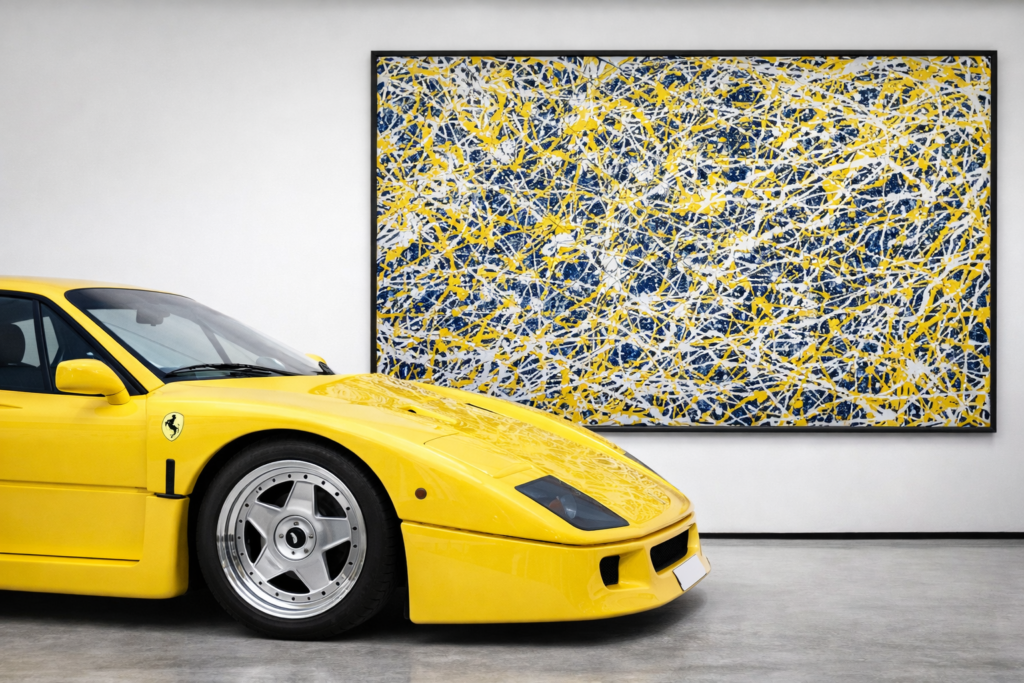
The narrative is clear:
Modern collector cars belong as much in galleries as they do on roads.
They are machines engineered for performance — yet appreciated as static sculpture.
Machines as Moving Art — Art as Static Motion
In elite automotive culture, the boundary between artwork and machine continues to dissolve.
Hypercars are displayed like sculptures.
Abstract canvases radiate motion like engines frozen in time.
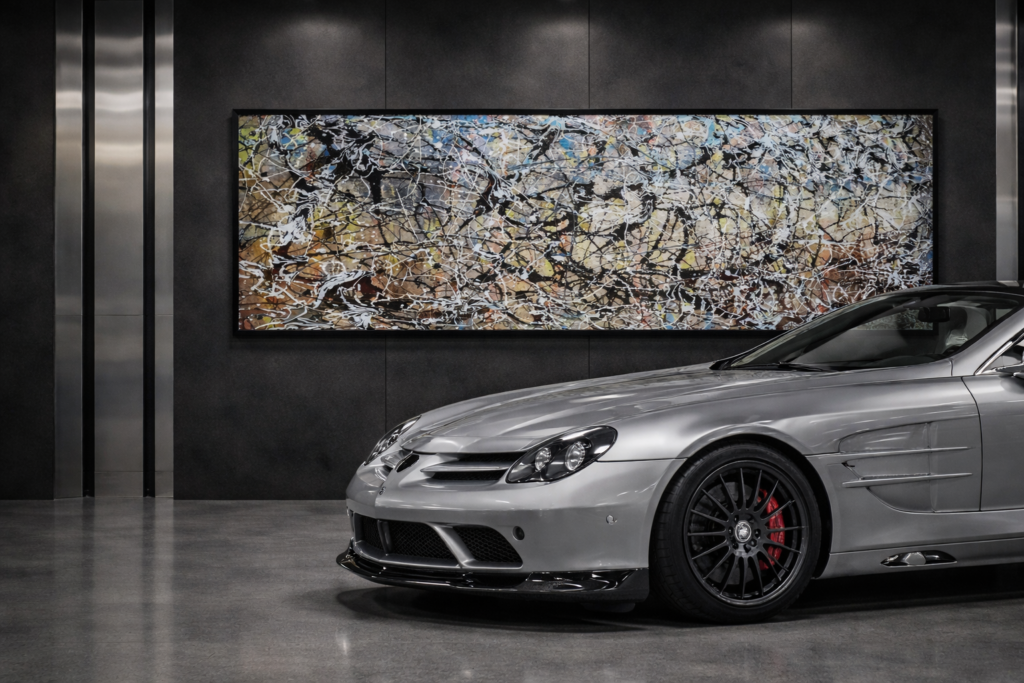
Together, they create environments that transcend storage — becoming curated sanctuaries of design, performance, and expression.
Where art captures motion……and cars embody it.