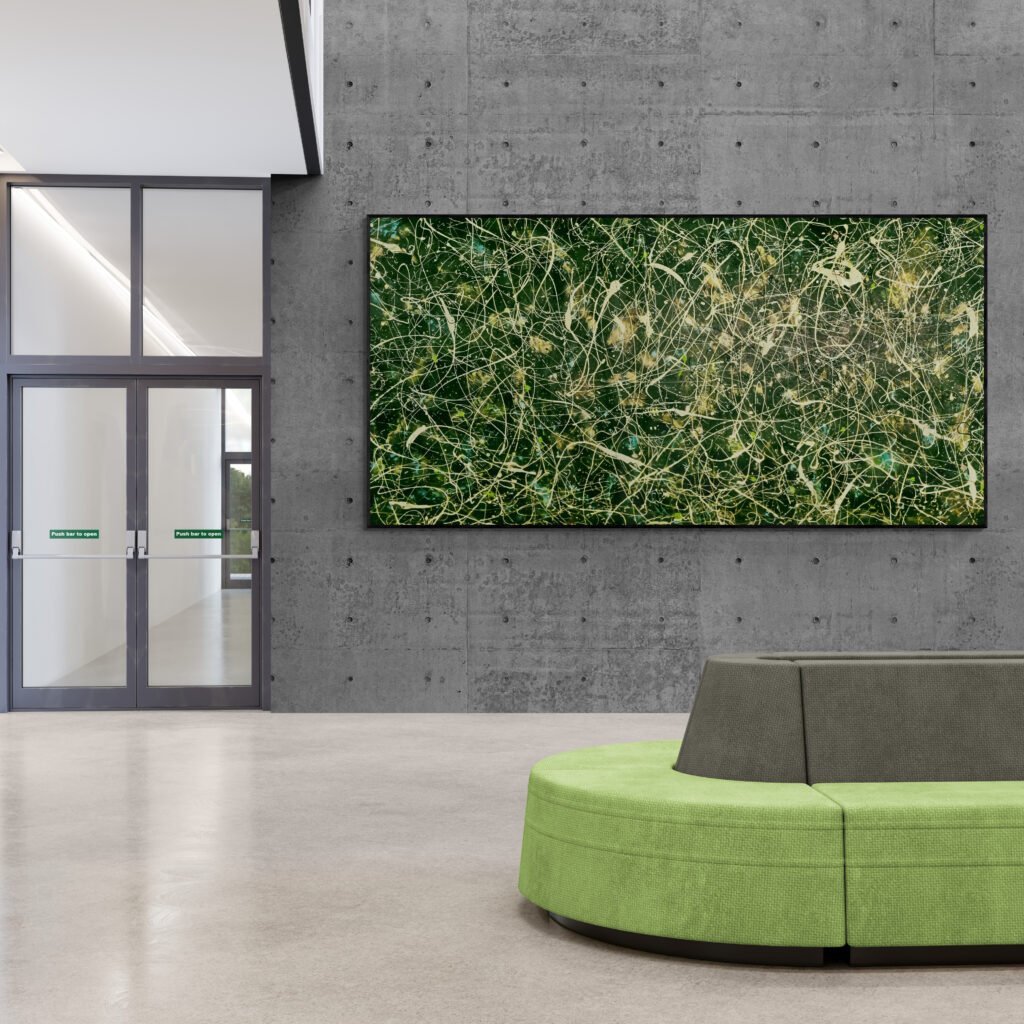
In contemporary interiors, art is no longer an afterthought — it is an integral part of spatial identity.
For collectors, designers and architects, selecting abstract artwork often goes beyond aesthetic preference. It involves aligning visual expression with architectural rhythm, material palette and emotional atmosphere.
Understanding how artists translate interior concepts into art reveals the depth behind commissioned and site-responsive abstract work — where painting becomes an extension of space rather than an isolated object.
Art as an Extension of Architecture
In design-led environments, abstract art interacts directly with built space.
Rather than depicting subjects, contemporary abstraction operates through:
- Scale
- Movement
- Density
- Color structure
- Surface presence
These elements allow the artwork to echo architectural qualities — reinforcing verticality, openness, symmetry or tension within the environment.
The painting does not decorate the space. It participates in its visual language.
Interpreting Spatial Dimensions
One of the first ways artists translate interior concepts is through scale interpretation.
Wall size alone is not sufficient. Artists evaluate:
- Ceiling height
- Viewing distance
- Furniture distribution
- Negative space
- Circulation flow
Large-scale works may be required to anchor expansive interiors, while panoramic formats may respond to horizontal architectural lines.
Scale becomes a structural decision, not merely a decorative one.
Translating Color Palettes
Color integration is another key bridge between interior design and abstract art.
Artists analyze environmental tones such as:
- Flooring materials
- Upholstery
- Wall finishes
- Natural light temperature
- Metallic or reflective elements
Rather than replicating these colors literally, abstract compositions interpret them — amplifying, contrasting or balancing palette relationships.
This approach maintains artistic authenticity while achieving spatial cohesion.
Material Dialogue With Interior Finishes
Surface materiality plays a subtle but important role in spatial translation.
Textural abstract works may echo:
- Stone surfaces
- Concrete finishes
- Wood grain
- Metallic detailing
- Glass reflections
Layered paint, iridescent pigments or enamel finishes interact with ambient light much like architectural materials do.
This creates continuity between artwork and environment at a tactile level.
Movement and Spatial Energy
Abstract expressionist works introduce movement into static spaces.
Gestural rhythms can:
- Activate large walls
- Soften rigid architecture
- Introduce dynamism into minimal interiors
Artists often consider how visual motion flows across the canvas in relation to room layout — guiding the viewer’s eye through the space.
This kinetic dialogue transforms painting into spatial choreography.
Emotional Atmosphere Translation
Beyond physical elements, artists also interpret emotional briefs.
Collectors and designers may seek atmospheres such as:
- Calm and meditative
- Energetic and bold
- Dramatic and immersive
- Warm and inviting
Through palette restraint, density control and gestural intensity, artists translate these abstract emotional goals into visual form.
Cohesive Multi-Work Installations
In large interiors, single artworks may not suffice.
Artists often develop cohesive series that function collectively across spaces — lobbies, corridors, suites or offices.
These bodies of work maintain:
- Palette continuity
- Gestural coherence
- Scale rhythm
While each piece remains original, together they create unified spatial narratives.
Collaboration With Designers and Architects
Successful spatial translation relies on collaboration.
Artists work alongside:
- Interior designers
- Architects
- Project managers
- Art consultants
Dialogue may involve:
- Mood boards
- Material samples
- Architectural plans
- Lighting studies
This collaborative exchange ensures the artwork aligns with the broader design vision.
Flexibility and Orientation
Some abstract works are intentionally orientation-flexible.
Unsigned fronts allow collectors or designers to rotate the artwork according to spatial requirements — vertical, horizontal or panoramic placement.
This adaptability enhances integration within diverse architectural contexts.
Logistics and Installation Planning
Large-scale interior projects require logistical foresight.
Artists consider:
- Shipping format
- Installation access
- Wall reinforcement
- On-site stretching or framing
Rolled canvas delivery often allows safer transport and easier handling for oversized works.
Balancing Concept and Artistic Freedom
While interior concepts guide direction, artists retain creative autonomy.
Overly prescriptive briefs risk reducing artwork to decorative replication rather than authentic abstract expression.
The most successful translations occur when conceptual input meets artistic interpretation.
Art as Spatial Identity
When interior concepts are effectively translated, abstract art becomes inseparable from the environment.
It shapes atmosphere, anchors architecture and contributes to experiential design.
Rather than occupying a wall, the artwork defines how the space is perceived and remembered.
Final Reflection
Translating interior concepts into abstract art is a dialogue between structure and expression.
Through scale interpretation, palette translation, material resonance and gestural movement, artists transform spatial ideas into visual presence.
The result is artwork that does not simply exist within interiors — it completes them.