In contemporary abstract art, an abstract artist signature style is not designed — it is developed.
Unlike branding in commercial industries, an artist’s visual identity emerges gradually through repetition of process, material exploration and intuitive decision-making over time.
Collectors often recognize a mature artistic voice immediately, even without seeing a signature. This recognition comes from coherence — a consistency of energy, gesture, composition and material presence that defines the artist’s work.
Understanding how this signature language forms offers deeper insight into the value and authenticity of contemporary abstract practice.
Style as an Evolution, Not a Formula
Early in an artist’s journey, experimentation dominates.
Different materials, palettes and gestural approaches are explored without fixed structure. This exploratory phase is essential — it allows artists to discover how paint behaves, how surfaces respond and how movement translates visually.
Over time, certain patterns begin to repeat:
- Preferred gestures
- Recurring densities
- Surface rhythms
- Material combinations
These recurring elements form the foundation of a recognizable visual language.
A signature style is not imposed — it crystallizes through sustained practice.
The Role of Process in Artistic Identity
In abstract expressionism, process is inseparable from style.
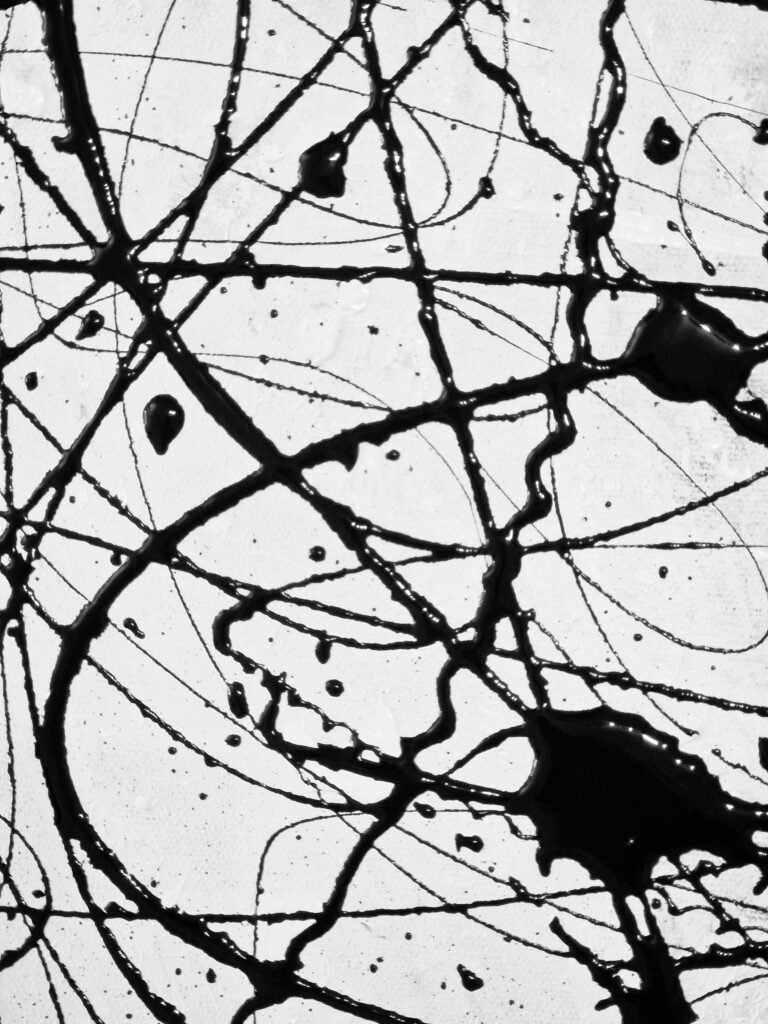
Artists working through gestural abstraction often develop distinctive physical methodologies. For example, floor-based painting allows full-body engagement with the canvas.
Movement around the surface influences composition, while gravity affects paint flow, drip behavior and layering outcomes.
As artists refine their interaction with materials, their gestures become increasingly identifiable — not through imitation, but through muscle memory and visual instinct.
The process itself becomes a signature.
Material Exploration and Experimentation
Material selection plays a defining role in stylistic development.
Contemporary abstract artists frequently expand beyond traditional acrylics to include:
- Industrial enamels
- Automotive paints
- Ceramic coatings
- Metallic pigments
- Iridescent finishes
Each material behaves differently — some flow, others resist; some reflect light, others absorb it.
Through repeated experimentation, artists learn how these mediums interact, layering them to create distinctive surface identities.
Over time, this material vocabulary becomes inseparable from the artist’s style.
Gesture, Movement and Rhythm
Gestural language is central to expressive abstraction.
No two artists move identically. Speed, pressure, direction and motion arcs differ — producing unique visual rhythms across the canvas.
Some works emphasize explosive movement and splashes. Others balance gestural energy with areas of calm and restraint.
Collectors often recognize this gestural handwriting instinctively, much like recognizing a musician’s sound or a writer’s voice.
Series and Cohesive Bodies of Work
Signature style becomes most visible across series.
Rather than isolated artworks, contemporary abstract artists often develop cohesive bodies of work exploring scale, palette or structural variations within a unified language.
Series allow:
- Deeper exploration of visual themes
- Controlled experimentation
- Spatial adaptation across formats
Limited editions and structured collections also emerge from this framework, maintaining stylistic coherence while preserving individuality within each piece.
Balancing Evolution and Consistency
A mature signature style balances two opposing forces:
- Evolution
- Recognition
Artists must evolve to avoid repetition, yet maintain coherence so their work remains identifiable.
This balance manifests through:
- New material integrations
- Palette shifts
- Scale expansion
- Surface experimentation
While the visual language develops, its core energy remains intact.
Authenticity vs Imitation
In contemporary art markets, signature style also protects authenticity.
Works that lack cohesive process or material logic often feel derivative — imitating surface appearance without underlying methodology.
Authentic signature styles, by contrast, are difficult to replicate because they stem from deeply ingrained process, not visual mimicry.
Collectors attuned to these subtleties can distinguish between genuine artistic identity and decorative imitation.
Spatial Translation of Style
Signature style does not exist in isolation — it interacts with architecture.
Artists creating large-scale abstract works must consider how gesture, density and palette translate across different spatial environments.
Some styles adapt seamlessly to residential interiors, while others are conceived for hospitality or corporate settings.
Understanding this spatial adaptability further defines an artist’s signature presence.
Collector Recognition and Emotional Continuity
Over time, collectors develop emotional familiarity with an artist’s work.
They recognize recurring energies, surface tensions and compositional balances — even across different formats.
This continuity fosters long-term collecting relationships, where acquiring multiple works builds a cohesive narrative within a collection.
Signature style becomes not only an artistic identifier, but a relational bridge between artist and collector.
Beyond Aesthetics: Philosophy of Practice
Ultimately, signature style extends beyond visual characteristics.
It reflects:
- Philosophical approach
- Relationship with material
- Conceptual focus
- Studio discipline
Some artists pursue reduction and silence. Others embrace density and intensity.
These philosophical orientations shape the visual outcomes that collectors experience as style.
Perspective
A contemporary abstract artist’s signature style is not a fixed aesthetic — it is the visible trace of an evolving process. An abstract artist signature style is not a fixed aesthetic — it is the visible trace of an evolving creative process
Formed through repetition, experimentation and material dialogue, it represents the convergence of gesture, surface and intention.
For collectors, recognizing this stylistic identity deepens engagement with the artwork — transforming it from isolated object into part of a broader creative continuum.