Contemporary abstract art is often described in many ways — expressive, gestural, minimal, emotional or conceptual. But beyond labels, contemporary abstraction is less about defining what we see and more about understanding how a work exists: how it is created, how it behaves materially and how it transforms the space around it.
From an artist’s perspective, contemporary abstract art is not a style confined by rules. It is a living visual language shaped by process, movement, material interaction and individual vision.
Rather than representing objects, landscapes or figures, abstract art explores energy, rhythm, balance and tension — elements that are felt before they are intellectually interpreted.
Beyond Representation: The Core of Abstract Expression
One of the defining characteristics of contemporary abstract art is the absence of representation.
There are no figures, no geometric constructions intended to symbolize external realities, and no visual storytelling in the traditional sense. Instead, the work exists as an independent visual experience.
Color combinations, density, contrast and movement replace recognizable forms. The viewer is not guided toward a specific meaning but invited to engage emotionally and spatially with the piece.
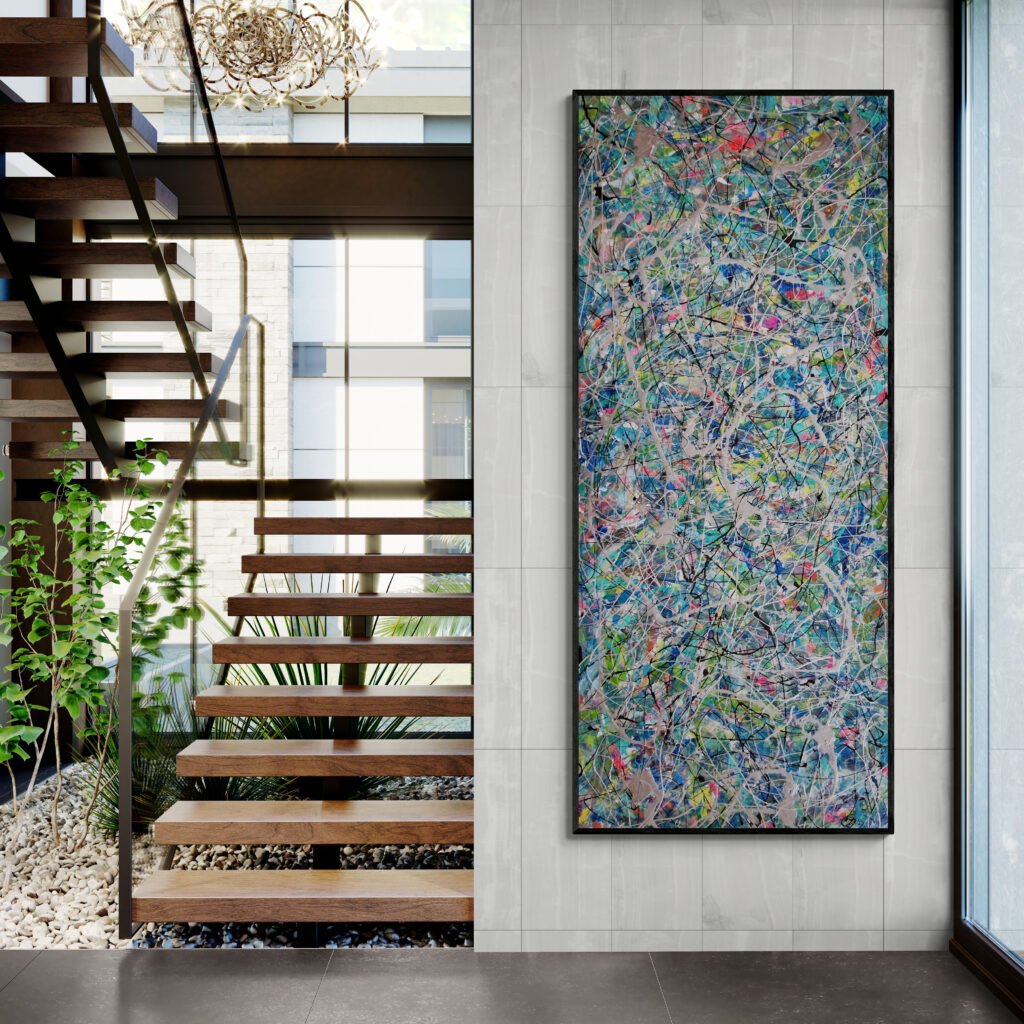
This freedom — both for the artist and the collector — is what makes contemporary abstraction so relevant in modern interiors and architectural environments.
Process as Language
In contemporary abstract expressionism, the process itself becomes part of the artwork’s meaning.
Unlike traditional studio painting created on an easel, many abstract works are developed directly on the floor. This approach allows the artist to move physically around the canvas, interacting with it from all angles.
Movement, gravity and material weight play an active role in the composition. Layers are built over time through gestures, drips, splashes and controlled interventions.
Some marks emerge spontaneously through the natural behavior of paint. Others are placed intentionally to restore balance or tension within the surface.
The final composition is not accidental — it is resolved through visual judgment developed through experience.
Material Experimentation in Contemporary Practice
Another defining aspect of contemporary abstract art is the expansion of materials beyond traditional fine art tools.
While acrylics remain foundational, many artists integrate unconventional mediums to create richer surfaces and more complex visual effects. These can include:
- Industrial enamels
- Automotive paints
- Ceramic coatings
- Spray pigments
- Metallic and iridescent finishes
This intersection between fine art and industrial materiality introduces textures, reflections and tonal depths that cannot be achieved through conventional paint alone.
The surface becomes not just painted, but constructed.
The Role of Texture and Surface Depth
Texture is fundamental to how contemporary abstract art is perceived.
Even works that appear visually minimal or monochromatic often contain multiple layers, densities and pigment variations. A painting that reads as “black,” for example, may contain numerous black tones created through different materials and finishes.
These subtleties create depth that changes depending on light, distance and viewing angle.
Unlike flat decorative prints, original abstract paintings possess a tactile presence — a physical surface that records the gestures, layers and decisions made throughout the process.
Color as Emotional Structure
In contemporary abstraction, color is rarely formulaic.
Some works explore vibrant, high-energy palettes combining multiple tones, metallics and contrasts. Others reduce themselves to one or two colors, focusing on nuance, texture and material interaction.
Monochrome works, in particular, challenge the viewer to engage with surface rather than hue — discovering complexity within apparent simplicity.
Color becomes an emotional structure rather than a representational tool.
Orientation, Space and Collector Interaction
Another distinctive characteristic of contemporary abstract art is its adaptability to space.
Rather than imposing a fixed viewing direction, some works are intentionally left unsigned on the front, allowing collectors to display them vertically, horizontally or rotated depending on architectural context.
This approach shifts the relationship between artwork and environment. The painting does not dictate placement — it collaborates with the space it inhabits.
In large interiors, this flexibility becomes especially valuable.
Originality and Physical Presence
Original contemporary abstract paintings are defined not only by image but by objecthood.
Each piece carries:
- Layer build-up
- Material density
- Surface relief
- Edge treatment
- Structural weight
Even in limited series, hand-painted processes ensure that no two works behave identically.
This physical uniqueness is what distinguishes original works from mechanical reproductions.
To formalize authenticity, original paintings are typically accompanied by a signed Certificate of Authenticity, confirming their origin and direct link to the artist’s studio.
Why Contemporary Abstract Art Resonates Today
Contemporary abstraction has gained prominence not because it is decorative, but because it aligns with how modern spaces function.
Minimal architecture, open-plan interiors and large walls benefit from artworks that introduce movement, depth and emotional resonance without imposing literal narratives.
Abstract art adapts across environments:
- Private homes
- Corporate spaces
- Hospitality interiors
- Architectural projects
It becomes part of spatial identity rather than visual illustration.
A Living, Evolving Language
Perhaps the most important aspect of contemporary abstract art is that it is not static.
Each artist develops a personal visual language shaped by materials, gesture, rhythm and conceptual approach. Over time, this evolves into a recognizable signature style — not through repetition, but through coherence of energy and process.
Understanding contemporary abstract art, therefore, is less about memorizing styles and more about recognizing authenticity, intention and material presence.
From an artist’s perspective, contemporary abstract art is a dialogue between control and unpredictability.
It is built through movement, layered decisions and physical engagement with materials. It exists not to represent reality, but to create an experience — one that interacts with space, light and the viewer’s emotional perception.
Whether encountered in a private residence or a large architectural setting, original abstract art offers something uniquely powerful: a work that cannot be replicated, only experienced.