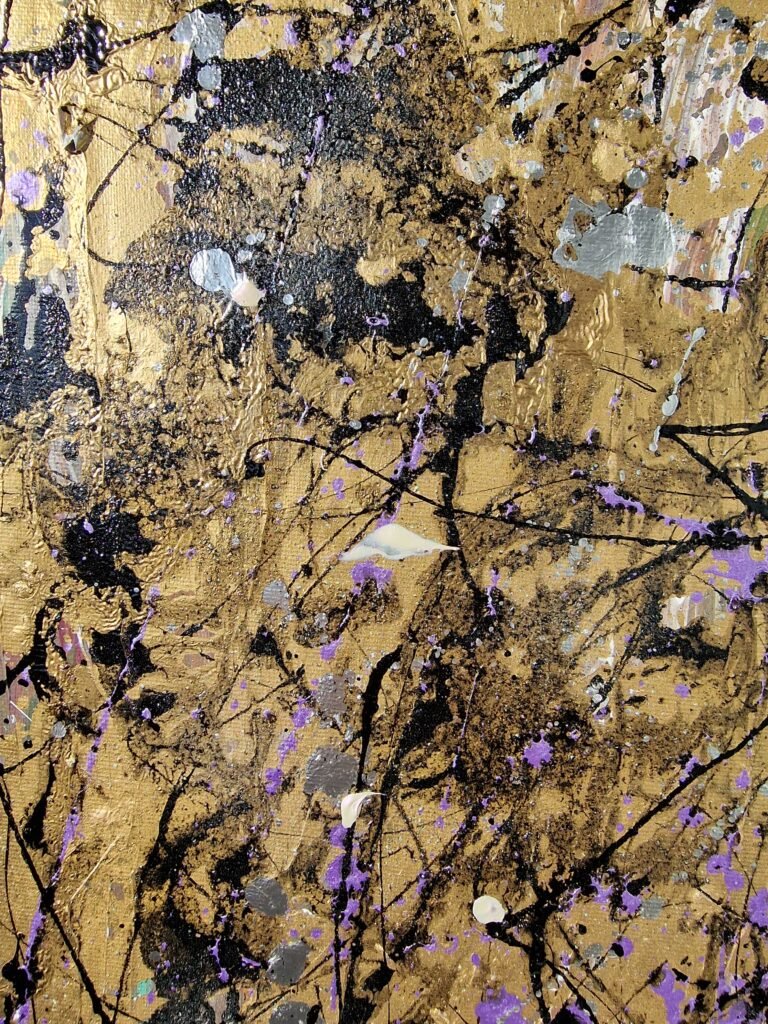
In abstract art, materials and finishes are not secondary details. They are a fundamental part of the artwork itself. They define texture, depth, how light interacts with the surface, and how the piece feels in real space.
In this guide, we explore why materials, surface treatment and presentation choices matter so much—especially in large-scale and statement artworks.
Why Materials Matter in Contemporary Abstract Art
Unlike flat decorative art, contemporary abstract expressionism often relies on physical presence: layers, density, movement and surface complexity.
At KooK, artworks are created using:
- Professional-grade acrylic paints
- Industrial and decorative enamels used in architecture and construction
- Acrylic spray paints and metallic sprays
- Automotive paints and ceramic enamels
- Metallic, iridescent and high-pigment materials
This combination allows for:
- Very intense or very restrained color fields
- Urban, raw or refined surfaces
- Metallic and iridescent effects that change with light
- Deep, complex textures built in layers
Color, Light and Surface Interaction
Many works include:
- Fluor or high-intensity colors
- Metallic and reflective pigments
- Multiple tones of the same color layered together
This means the artwork never looks exactly the same throughout the day. Depending on light, angle and distance, new details and depths appear.
The Importance of Texture
Texture is a core element of the work. Even in pieces that appear calm or monochrome, the surface is built using:
- Multiple layers
- Variations of material density
- Subtle changes in tone and gloss
For example, some black paintings may contain five or more different black pigments, creating richness and depth within a single color family.
A Physical, Action-Based Painting Process
All artworks are created on the floor, allowing full freedom of movement around the canvas.
Instead of traditional brushes, the process involves:
- Sticks and unconventional tools
- Pouring, dripping and controlled splashing
- Speed, gravity and body movement
- Layering over time
This is a form of contemporary action painting, where chance and control coexist. Some elements appear spontaneously, others are placed deliberately.
Durability and Professional Finishing
All materials are selected not only for visual impact, but also for:
- Long-term stability
- Resistance of pigments
- Surface durability
Each piece is finished to ensure it can live for decades without losing its presence or integrity.
Orientation and Display Freedom
Artworks are never signed on the front. Each piece is signed on the back, which allows:
- Vertical or horizontal display
- Even rotated orientations if the space calls for it
The artwork adapts to the architecture instead of forcing the space to adapt to it.
Frameless or Framed?
Most large abstract works are designed to work perfectly as frameless stretched canvases, emphasizing the raw physical presence of the painting.
However, some interiors benefit from:
- Floating frames
- Minimal external frames
Both options are valid and depend on the character of the space.
Why This Matters Especially for Large and Custom Art
In large or architectural spaces, materials and finishes are what separate:
- Decorative objects
- From true spatial artworks
This is why large-scale and custom projects focus so much on surface, material presence and physical impact. You can explore how these projects work in our Projects section.
Final Considerations
Materials, finishes and presentation are not just technical choices. They are part of the artistic language itself. They define how the artwork lives in space, how it reacts to light, and how it is experienced over time.
In contemporary abstract expressionism, the surface is not just a support—it is part of the story.