
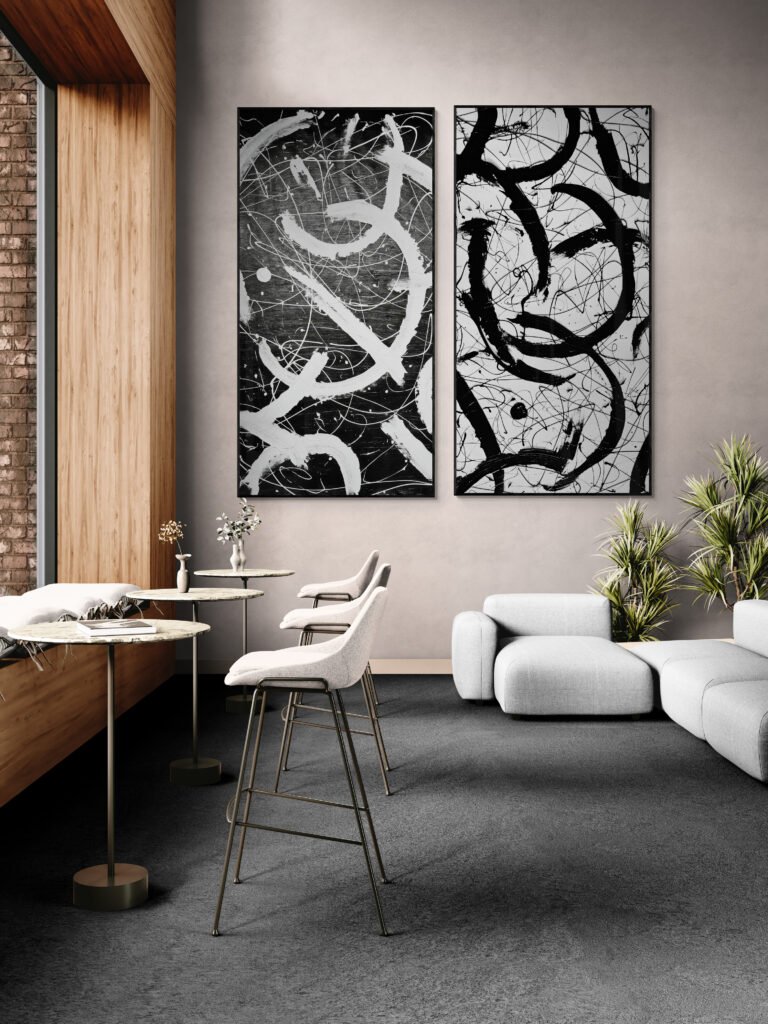
Decorating with more than one artwork is not just about filling walls. When done well, multiple paintings across different rooms can create a cohesive visual language that ties the entire space together and makes the interior feel intentional and curated.
In this guide, we’ll explore how to combine several artworks across rooms without turning the home into a random collection of unrelated pieces.
Think of the Home as One Visual Project
Instead of choosing artworks room by room in isolation, it helps to think of the entire home as one continuous visual experience.
This does not mean that every room has to look the same—but there should be a sense of dialogue, rhythm and continuity between spaces.
Choose a Common Thread
To create coherence, the artworks should share at least one common element:
- A similar color family
- A related technique or texture
- A consistent level of intensity or calmness
- A shared visual language or mood
This common thread allows each piece to be different while still feeling part of the same world.
Variation Within Consistency
A cohesive collection does not mean repetition. In fact, the best results usually come from variation within a clear framework.
For example:
- Different sizes, but similar palette
- Different compositions, but similar technique
- Different intensity levels, but similar atmosphere
This creates visual interest while maintaining unity.
Let Each Room Keep Its Own Character
While the overall project should feel coherent, each room still has its own function and mood. A living room, a bedroom and a hallway do not need the same energy.
Use the shared visual language as a base, then adjust intensity, scale or calmness depending on the space.
Scale and Importance: Not All Rooms Need the Same Impact
Some spaces deserve stronger, more present artworks (main living areas, entrances), while others work better with more subtle or quieter pieces.
If you are unsure about scale in main rooms, these guides may help:
Use Series or Sets When It Makes Sense
One of the easiest ways to achieve coherence across rooms is to work with a series of artworks developed together.
A series allows:
- Strong unity across different spaces
- Natural variation within a controlled framework
- A clear artistic identity throughout the interior
This approach is often used in large homes, hotels and architectural projects. You can explore how this works in our Projects section.
Transitions Matter: Hallways and Connecting Spaces
Corridors, staircases and transitional spaces are ideal places to bridge different atmospheres. Art in these areas can gently shift the mood from one room to another while maintaining continuity.
Common Mistakes to Avoid
- Buying each artwork in isolation without a bigger picture
- Mixing too many unrelated styles and palettes
- Trying to make every room equally strong and dominant
- Forgetting that the house should feel like one story, not many disconnected ones
What If You Want a Fully Coherent Collection?
If you want a truly unified result across many rooms, a custom series or coordinated set of artworks can be the best solution. This allows the entire collection to be developed with the space in mind from the beginning.
If this is something you are considering, you can explore coordinated and large-scale projects in our Projects section.
Conclusion
Combining multiple paintings across rooms is about thinking in terms of rhythm, dialogue and continuity. When done well, art stops being isolated decoration and becomes part of the architecture and identity of the home.